Agriculture and Artificial Selection: Domestication through the Lens of Cabbages

Did you know that kale, cauliflower, Brussels sprouts, and many other cabbages are all part of the same species, Brassica oleracea? If that interests you, join us for a deep dive on domestication and artificial selection!

Domestication and agricultural selection are a huge part of our daily life, from our fur, feather, scale, or leaf babies to food and clothing. Continue reading if you want to learn more about how they came to be that way!

A bit of history

We first domesticated plants (most likely non-intentionally at first) around 13,000-11,000 years ago in the Fertile Crescent. Some of the first crops include wheat, barley, flax, and legumes. These plants started as wild, and over long periods of time, artificial selection changed them into the crops we know today.

However, domestication is not synonymous with agriculture; agriculture is dependent on domesticated species, but domestication does not automatically lead to agriculture.

Animals were not all domesticated in the same place or at the same time. The current scientific consensus points to multiple points of origin: for example, dogs are thought to have been domesticated around 12,000 to 10,000 BCE in modern-day Iraq. Other archeological finds let us think that they might have been domesticated more than once: dated from 10,000 to 7,000 BCE in England, Palestine, Japan, and the US. Some scientists even proposed dates as early as 33,000 years ago (Freedman and Wayne 2017).

A map of the domestication places of the main domesticated animals and crops. Among the most notable: the difference between Old World and New World farm animals and plants, cats in Egypt, overlaps between the Fertile Crescent, Europe, and Asia.
Probable domestication places of the main domesticated animals and crops. Figure from Michael Park’s Introducing Anthropology, 4th ed. 2008, p.237 (Note, this is an older map, and the scientific consensus has changed since it was drawn.)

Most farm animals (sheep, goats, pigs, and cattle) are thought to have been domesticated around 6,000 BCE in Mesopotamia.

Domestication of everything and anything?
Not all species, animal, plant, or other, are suitable for domestication. The wanted characteristics are: hardiness, social behavior, herd dynamics, utility, easy reproduction, and manageable husbandry. The last two criteria in particular let us to select which individuals are permitted to breed. Thus allowing us to select for traits we would like to see in the offspring, which is the guiding principle behind artificial selection (Driscoll et al. 2009).

Domestication is a gradual, multigenerational process in which humans selectively breed animals for specific functions and benefits. It is also characterized by a mutual (but not equal) advantage in the form of protection and care extended to the selected individuals, as well as increased numbers and range (although in plants it can interfere with seed dispersal).

Domestication is a lineage-level process that impacts the genetic material of the population, whereas taming only brings behavioral modifications at an individual level.

Did you know? Humans are not the only domesticators; 3 separate insect groups each domesticated fungi, some as far back as 30 million years ago!

And what about cabbages?

B. oleracea probably originated from the Eastern Mediterranean region, and the earliest physical evidence of domestication points to around 3,000 years ago. Modern crop cultivars mostly come from Europe or Asia.

Suitable habitat for Brassica cretica, probable ancestor of modern domesticated B. oleracea varieties. This habitat is mostly found in the coastal and island regions of Greece and Cyprus.
Suitable habitat for Brassica cretica, probable ancestor of modern domesticated B. oleracea varieties during the late Holocene (4,200 years ago to present). Figure 3C from Mabry et al. 2021.

From the original wild Brassica oleracea, multiple different traits have been selected for by humans (passive): enlargement of leaves for kale, proliferation of lateral buds for Brussels sprouts, enlarged flowers and arrested development for broccoli, etc.

Early artificial selection targeted whole traits. But nowadays, it works mostly at the gene level, using marker-assisted selection and genomic selection. Both methods allow for quicker selection of desirable individuals, thus accelerating the creation of new varieties.

Mini-Game! “Associate crops to their signature trait!” (Answers at the bottom of the article)

License: Created in https://BioRender.com

Brussels sprouts are a good example of modern artificial selection. Until quite recently, they were bitter and less sought after. But in the 1990s, a Dutch scientist, Hans van Doorn, selectively cross-bred modern high-yielding plants with historic, less bitter-tasting varieties. These new Brussels sprouts were less bitter and sweeter, but retained the high-yield abilities of the modern varieties.

We humans started domesticating plant and animal species some 10 to 15,000 years ago. This ever-ongoing process changed its methods over time, from only trait selection to genetics, but the principle stays the same as for our ancestors!

Mini-game answer (click me!)

A = 3
B = 4
C = 2
D = 1

Lexicon

  • Cultivar: a cultivated plant variety or strain that retains artificially selected traits when cultivated and propagated.
  • Variety (agriculture): a population of plants that may occur naturally; they also present specific and stable traits.

Sources

Rabbithole starter

The Cat Coat Color Conumdrum: Why Some Colors Come With a Sex Bias

You might have heard that “all calico cats are female”, but do you know why? The short answer is “genetics”, but if you want more details, buckle up!

Some of the most common cat coat colors like black or tortoiseshell aren’t just random; they follow rules rooted in genetics and sex. Behind the patterns and colors of a cat’s fur lies a fascinating story about chromosome inheritance.

Follow me for a peek into the fascinating world of sexual chromosomes and genetic expression!

Basics of genetics

Let’s start with the foundation: a quick tour of genetics 101. 

A gene is a part of the genome, a unit that encodes a protein. Its locus is the particular location of that gene on the physical chromosome. An allele is one version of that gene, there are usually more than one per gene. These alleles can be responsible for changes, big or small, in the protein encoded by the gene.

To impact the cell and its environment, a gene has to be expressed for the corresponding protein to be produced. Cells in multicellular organisms like animals are specialized and do not express all genes in their genome. The cocktail of proteins they produce leads to them presenting different characteristics, which translates into a phenotype, or the sum of observable characteristics of an individual organism.

Before we get into fur colors, we need to talk about chromosomes, and one pair in particular. Cats have 19 pairs of chromosomes, 18 of which are called autosomes and do not differ between males and females. What interests us right now though is the last chromosome pair, the sexual chromosomes: XX for the females, and XY for the males (generally, there are a few exceptions; we will discuss some of them here).

The X chromosome carries significantly more genes than the Y chromosome: around 1000 genes for the X chromosome, compared to around 20-50 genes (estimated) on the Y chromosome. This huge difference would lead to an imbalance in genes expressed between female and male cats. To equalize this, an irreversible process called Lyonization (or X-inactivation) happens in each cell of a female (XX) embryo early on during embryonic development: one of the X chromosomes is randomly deactivated.

Neighboring cells might not inactivate the same X chromosome. These cells later divide themselves during development, thereby doubling each time the size of the cell cluster that inactivated that one specific X chromosome.

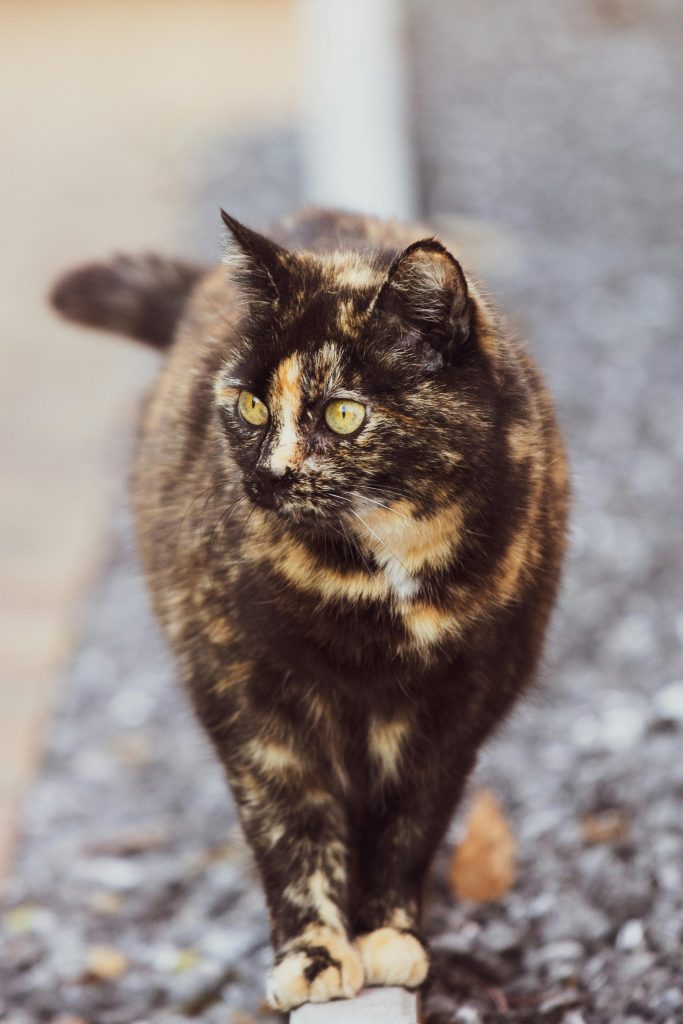
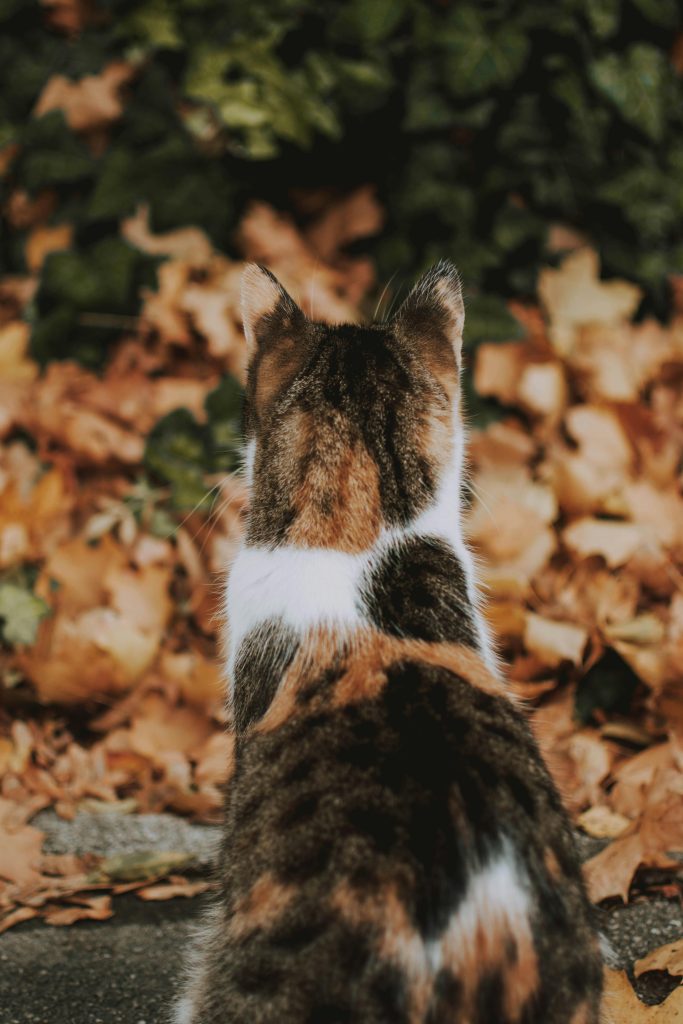
This mosaic of different active X chromosomes leads to patches of color on the fur, as you can see here:

A tortoiseshell cat
A tortoiseshell cat. Credits: Vincent M.A. Janssen on Pexels.
A calico cat
A calico cat. Credits: lil artsy on Pexels.

Fun fact: Tortoiseshell cats tend to have smaller, less defined patches than calicos.

Not all species that reproduce through sex and, therefore, have sexual chromosomes solve the problem of the gene number imbalance between the X and Y chromosomes in the same way. Mammals, including cats and humans, use X-inactivation, whereas fruit flies (Drosophila) use hyper transcription. Some worms, like C. elegans, a worm commonly used in laboratories, use hypo transcription of either sexual chromosome.

Black cats are mostly males

Every cat’s fur color is built from just two pigments, black and orange, or the complete absence of pigment, which shows up as white.

Pigment production in cats isn’t random, it’s the job of specialized cells that decide what colors show up where. Melanocytes are the cells in the skin and hair that determine their color. For this, they have access to two different pigments: eumelanin (black) and phaeomelanin, which is red-orange. A cat with melanocytes only expressing eumelanin might be black or gray, depending on the quantity of pigments.

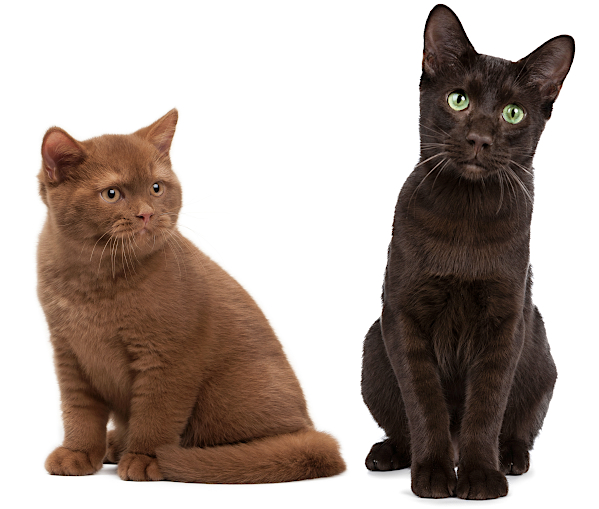
One gene is primarily responsible for eumelanin, it is called locus B. On this gene, the allele B is dominant and leads to a black phenotype, i.e, a black cat. The alleles b and b1 (or b’) are both recessive and lead to a chocolate and cinnamon phenotype, respectively.

A cinnamon British shorthair and a chocolate Havana Brown
On the left, a cinnamon British shorthair, and on the right, a chocolate Havana Brown. Credits: UC Davis Veterinary Genetics Laboratory.

Two genes, locus A and locus O, are responsible for the production of phaeomelanin. Locus A’s allele is recessive, but mostly blocked if the dominant allele O is also present. Locus O is situated on the X chromosome, it is X-linked. The dominant allele O leads to a cat with fur in the orange tones, while the recessive allele o leads to a black or brown cat.

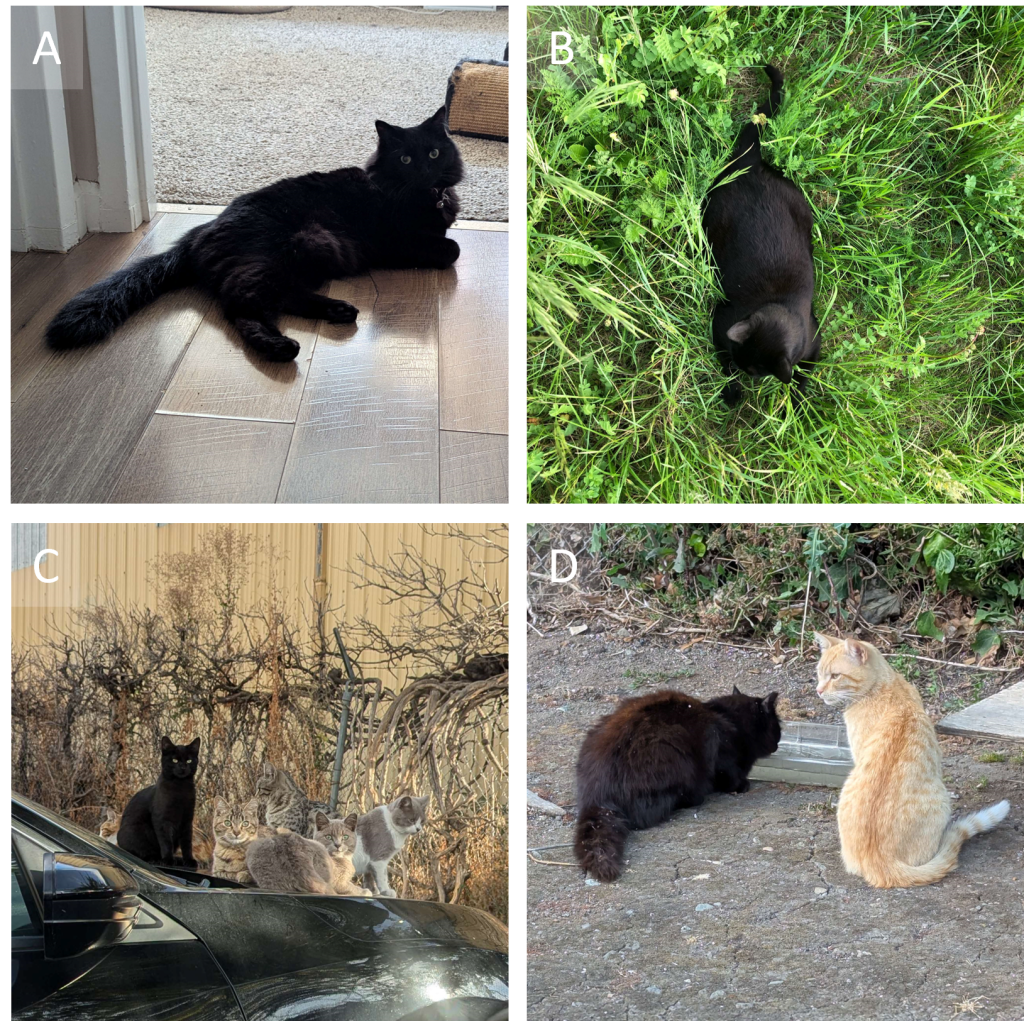
Therefore, for a cat to be black, it needs a combination of three alleles on all its corresponding chromosomes: B on locus B, a on locus A, and o on locus O. Since locus O is X-linked, male cats (with XY chromosomes) only need one allele o, whereas female cats (with XX chromosomes) need two identical versions of allele o which is statistically less probable. So next time you spot a black cat, there is a 75% chance you are looking at a male.

Four pictures, each with one black cat and numbered A to D.
Credits: A, C, D: Crazy Lab Lady. B: Crazy Lab Lady’s sister.

What about tortoiseshell and calico cats?

Tortoiseshell cats are bicolor cats with a mixture of red (phaeomelanin) and black-based (eumelanin) colors, without white. Calico cats are tortoiseshell cats that also have white in their fur (they are sometimes called “tortoiseshell and white”); they are tri-color cats.

Now we need to remember the patches of color on the fur, visual reminders of the random X-inactivation process. Both locus O, responsible for the orange phenotype, and locus B, responsible for the black phenotype, are located on the X chromosome. Some patches might express the black phenotype, and some others the orange phenotype, leading to a tortoiseshell cat.

Male cats do not undergo the Lyonization process during development due to their only one X chromosome. This is also the reason why they can only have either the black or orange phenotype, but not both at the same time (usually).

Male calicos

Male calico cats are very rare, and three genetic causes have been identified so far.

  1. If a cat receives two X chromosomes and one Y chromosome from its parents, it is XXY. Its phenotype is male, although such cats are generally sterile. Due to the presence of the two X chromosomes, an XXY cat can be calico, by the same mechanism as a female (XX) cat.
  2. The XXY condition can sometimes arise after conception, in which case not all cells of the cat have the same number of chromosomes. This is called a “mosaic individual” and can translate to different fur colors on the same cat.
  3. Rarely, two embryos fuse while in early development. The resultant cat is a “chimera” and can present red- and black-based fur colors if the embryos had different color genotypes.

Did you know? “Lyonization” is named after Mary F. Lyon, who uncovered the mystery of X-chromosome inactivation in 1961.

As said before, calico cats are tricolor. So, where does the white come from? Another gene, named KIT, is primarily responsible for this. It disrupts the production and migration of melanocytes to the hair.

Multiple alleles of this gene have been characterized, including two dominant ones: Dominant white, which leads to a completely white fur, and White spotting, which leads to white patches on an otherwise colored cat. Several recessive alleles for this gene are also known, like w (or N, no white at all), wg (or Birman white gloving allele, white “gloves” at the paws), and wsal (or salmiak: a tuxedo cat, but each black hair in the fur fades to white, from root to tip).

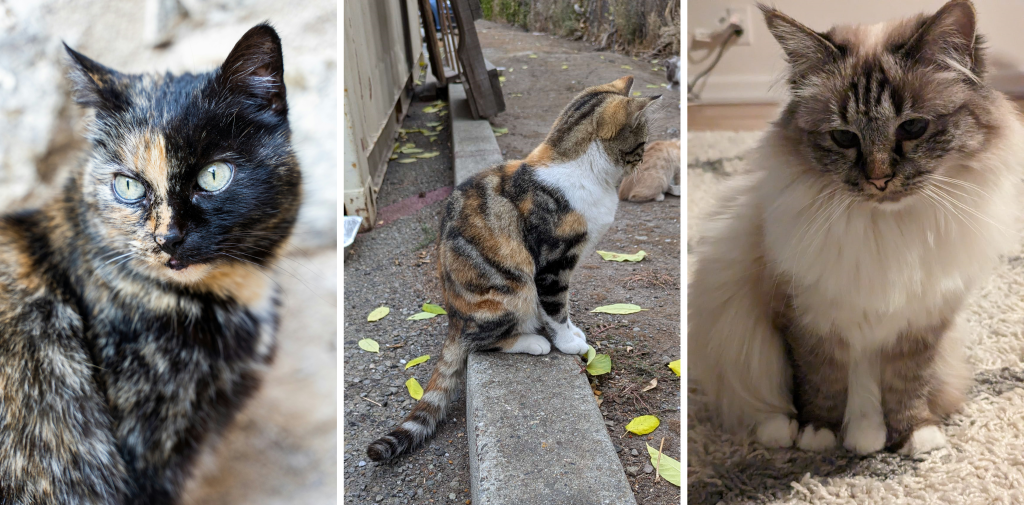
A tortoiseshell cat, a calico cat, and a Birman cat.
Left: a tortoiseshell cat (Credit: Gabriella Clare Marino on Unsplash)
Middle: a calico cat (Credit: Crazy Lab Lady)
Right: a Birman cat, with the characteristic white paws (Credit: Crazy Lab Lady)

In conclusion, both male black cats and female calicos are the norm because the genes responsible for the orange and black phenotypes are located on the X chromosome.

I hope you learned something interesting about the genetics of our furry friends and internet stars.

Don’t hesitate to tell us what you thought of this first blog article. What would you like us to talk about next time?

Mini-game answer (click me!)

The female is in B!

Sources

Rabbithole Starter